Archive Special Editions Glossary Earnings Analysis
April 17, 2026 (Friday)
The Morning Briefing
Atlas Morning Brief
April 17, 2026 (Friday)
Loading…
0:00-11:13
SPEED

1The Nasdaq logged its 12th consecutive gain — the longest winning streak since July 2009 — as the S&P 500, Nasdaq Composite and Dow all closed at fresh all-time highs. The S&P 500 ended at 7,041.28 (+0.26%), the Nasdaq Composite at 24,102.70 (+0.36%), and the Dow at 48,578.72 (+0.24%). The Nasdaq's 12-session run is its longest since July 2009. TSMC's earnings rekindled broad optimism over AI demand, leading a technology-driven advance.

2Even with a subdued VIX, the SKEWSKEW Index (Tail Risk Gauge)Calculated by the CBOE, SKEW quantifies the probability of a three-sigma-scale decline priced into S&P 500 options. Readings typically range between 100 and 150: 100 implies the market is not pricing extreme downside risk, while 150 indicates historically elevated tail-risk hedging demand. index remains historically high, keeping the "silent crisis" signal lit. The US 10-year yield sits around 4.31% and the 2–10Y spread has normalized to roughly +0.50%. The VIX closed at 18.17 (-1%) — a calm surface — yet the SKEW index stood at 150.36 as of April 8, historically elevated, suggesting institutional investors continue to hedge extreme downside scenarios in a classic "silent crisis" pattern.

3Iran peace negotiations remain deadlocked as JPMorgan's Dimon and Fed Chair Powell flag inflation risks. Speculation of progress helped crude stabilize, with WTI around $92.56/barrel. President Trump said the war is "close to ending," but Iran rejected Washington's proposal for a 20-year enrichment halt, countered with five years, and the US rejected that — leaving talks stuck. USD/JPY weakened further to 159.24. JPMorgan CEO Jamie Dimon warned that "inflation is the uninvited guest at the party," and Fed Chair Jerome Powell made clear a rate cut this year is "not guaranteed" unless tariff-driven inflation decelerates.
Sector Performance (April 16 close)
Semiconductors SMH +2.35%
Technology XLK +1.60%
Communication Services XLC +0.47%
Utilities XLU +0.22%
Materials XLB +0.18%
Consumer Discretionary XLY +0.13%
Real Estate XLRE +0.07%
Consumer Staples XLP +0.05%
Industrials XLI -0.13%
Financials XLF -0.14%
Energy XLE -0.34%
Health Care XLV -0.71%
S&P 500 7,041.28 +0.26%
NASDAQ 24,102.70 +0.36%
Dow 48,578.72 +0.24%
Russell 2000 2,394.80 +0.45%
VIXVIX (Volatility Index)A measure of expected volatility on S&P 500 options. Readings below 20 indicate calm, 20–30 caution, above 30 fear, and above 40 panic. 18.17 -1.00%
US 10Y 4.31% -2bp
USD/JPY 159.24 +0.12%
WTI $92.56 +1.85%
Gold $4,867.30 +2.10%
BTC $74,786 +0.81%
39/100
Caution
Composite of 8 Indicators — Caution Zone (31–50)
Reference date: April 16 close | Change from prior issue (4/15 → 4/16): 36 → 39 (+3pt ↑ slight deterioration)
🔔 "Silent Crisis" signal active ★★★★★ VIX<20 and SKEW>135
Show breakdown of 8 indicators (click to toggle)
VIXVIX (Volatility Index)A measure of expected volatility on S&P 500 options. Readings above 20 signal caution, above 30 fear. (Fear Gauge)
18.17
28
SKEWSKEW IndexCBOE's tail-risk gauge. Reflects demand for out-of-the-money puts on the S&P 500. 100 is neutral, above 130 signals caution, above 140 indicates elevated tail risk. (Tail Risk)
150.36
97
Yield CurveYield Curve (10Y–2Y Spread)The difference between the 10-year and 2-year Treasury yields. Positive means normal (long rates above short), negative (inverted) has historically preceded recessions. (10Y–2Y)
+0.50%
28
10Y Treasury Yield
4.31%
42
EPSEPS (Earnings Per Share)A company's net income divided by shares outstanding — the single most important profitability-per-share measure. "EPS Revisions" refers to analyst upgrades or downgrades of EPS forecasts. Revisions
Flat (80% beat)
45
Fear & GreedCNN Fear & Greed IndexCNN's market sentiment gauge (0–100). 0–25 = Extreme Fear, 25–45 = Fear, 45–55 = Neutral, 55–75 = Greed, 75–100 = Extreme Greed. Widely used as a contrarian indicator.
72
40
SPXA50R (Breadth)
68%
30
% Above 200-day MA
+6.83%
38
Surface prices continue to set record highs, yet SKEW reached 150.36 on April 8 — a historically elevated level — keeping the "silent crisis" signal lit as institutional investors continue hedging tail risk. With VIX subdued at 18.17, the S&P 500 now sits +6.83% above its 200-day moving average. Multiple indicators are flashing early signs of overheating, so we would be cautious about adding large new positions. That said, the yield curve and EPS trend have not broken down — this is not yet the moment to turn fully defensive.
TOP STORY
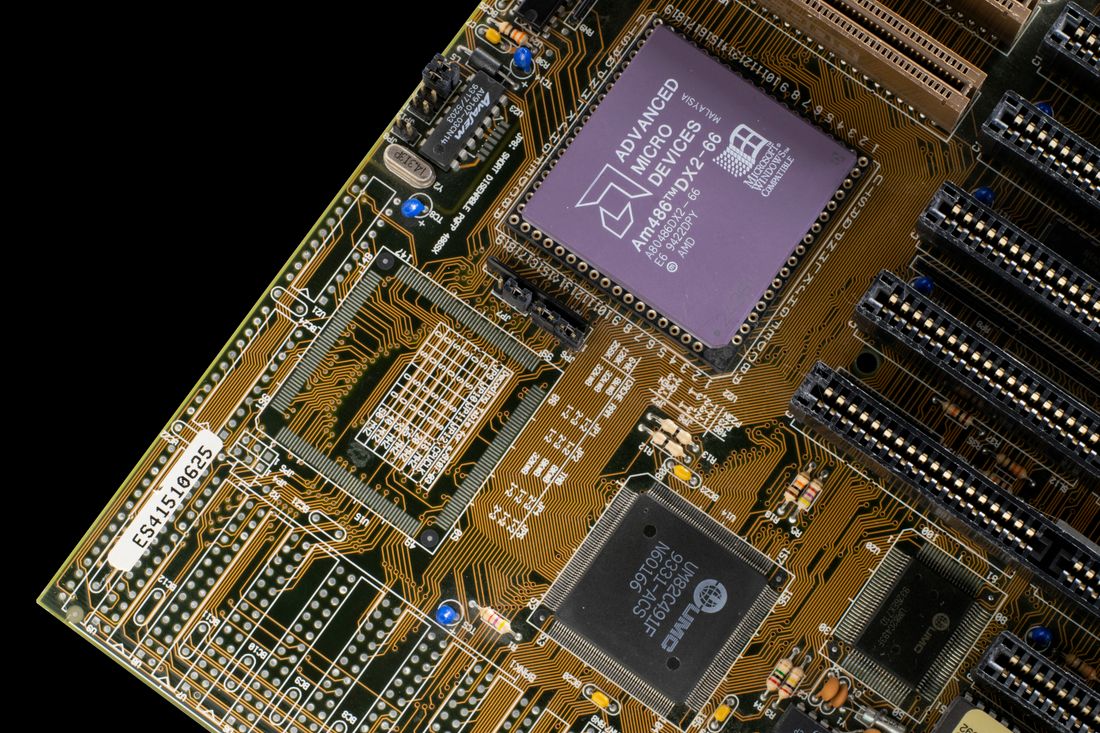
Semiconductor microchip close-up
Photo: Pexels
EARNINGS

TSMC Q1 Earnings: Net Income Surges 58% to Record High — AI Demand "Extremely Robust," 2026 CapEx Lifted to Top of $56B Range

Taiwan Semiconductor Manufacturing Company (TSMC) reported Q1 2026 earnings on April 16. Revenue came in at NT$1.134 trillion (about $35.7B), up +35.1% year-over-year, while net income reached NT$572.5B (+58%) — a record high for a fourth consecutive quarter. AI and HPC (high-performance computing) accounted for 61% of sales, and 3nm leading-edge process nodes reached 25% of total revenue (versus 6% in Q3 2023). CEO C.C. Wei described AI demand as "extremely robust," raised the 2026 full-year USD revenue growth outlook to more than 30%, and lifted capital spending to the upper end of the prior $52B–$56B range — with 80% earmarked for the 2nm leading-edge node. Q2 revenue guidance is $39.0B–$40.2B (+10% QoQ). The results reaffirmed the structural reality that Nvidia's Rubin generation, AMD's MI400, and the custom silicon for Google, Amazon and Meta are all concentrated on TSMC's leading-edge nodes.

Why it matters: TSMC is widely regarded as the core of the AI supply chain. The decision to raise CapEx to the top of the range — not in a single quarter but as an annual commitment — is a strong supply-side signal of conviction in the 2026–2027 AI capex cycle, and establishes the precondition for continued AI infrastructure spending by customers such as Nvidia, AMD and Google.
📝The Atlas Daily editors' take
With 2nm ramping into customer volume production from 2H 2026, TSMC's CapEx hike is a powerful demand-side signal that "AI demand won't break next year either." Memory (HBM) and advanced packaging (CoWoS) remain the real bottlenecks, however — TSMC can keep earning while Nvidia and other customers may still struggle to match actual deployment velocity on the ground.
Netflix on screen Photo: Pexels
EARNINGS CNBC / Bloomberg
Netflix Beats on Revenue and EPS but Q2 Guide Disappoints — Co-founder Reed Hastings to Step Down After 29 Years on the Board
Netflix reported Q1 results after the close on April 16. Revenue of $12.25B (consensus $12.18B) and adjusted EPS of $1.23 (consensus $0.76) both beat the Street. However, Q2 guidance for revenue of $12.57B (consensus $12.64B) and EPS of $0.78 (consensus $0.84) came in below expectations, triggering disappointment selling. In the same release, co-founder Reed Hastings announced he will step down from the board at the next shareholder meeting, ending a 29-year run at the company he co-founded in 1997. The advertising business reiterated its 2026 full-year outlook of roughly $3B in revenue (nearly double year-over-year). Shares fell around -8% in after-hours trading.
Why it matters: Netflix's "founder retirement" and early "growth deceleration" signals arrived in the same release. The FY26 full-year revenue guide of $50.7B–$51.7B (+12–14%) was maintained, but the soft Q2 print sharpens the market's view of the subscription-growth ceiling in developed markets that has been building since 2H 2025.
AI chip / processor board Photo: Pexels
TECH Reuters / CNBC
AMD Jumps +7.8% to $278.26 — OpenAI MI450 Supply Ripple Effects Begin in Earnest
AMD rose +7.80% to close at $278.26 on April 16, adding about $80B in market value in a single session. The catalyst: TSMC's earnings effectively confirmed from the customer side that AMD's MI400 series will be manufactured on the N2 node. Management has signaled that execution of the 6-gigawatt AI chip supply agreement with OpenAI announced in October 2025 — with MI450 revenue recognition starting in 2H 2026 — could drive more than $100B of new revenue over four years through its ripple effects. ON Semiconductor (+9.75%) and Lumentum (+9.35%) followed higher.
Why it matters: This is AMD's best shot at breaking Nvidia's dominance in the AI GPU market. With TSMC's 2nm / CoWoS supply plan now looking more concrete, the "revenue recognition from 2H 2026" narrative around AMD is finally acquiring real substance.
Office interior Photo: Pexels
ECONOMY DOL / Bloomberg
US Initial Jobless Claims Fall to 207K — Largest Weekly Decline Since February, Labor Market Remains Resilient
Initial jobless claims for the week ended April 11 came in at 207,000 (-11,000 week-over-week), the largest weekly decline since February and below the 220,000 consensus. Continuing claims held at a low 1.885 million. Fed Chair Powell and several Fed officials have been trimming expectations for rate cuts this year, citing a lack of visible deceleration in tariff-driven inflation; the resilience of the labor market reduces near-term recession risk. CME FedWatch shows only about a 1-in-3 probability of a single rate cut this year.
Why it matters: If the labor market does not crack even under tariff-driven inflation and geopolitical risk, pressure on the Fed to cut fades — and "higher for longer" looks increasingly likely. That is a headwind for rate-sensitive small caps and long-duration bonds, but a tailwind for core tech and AI. An asymmetric setup.
Oil and energy related image Photo: Pexels
GEOPOLITICS Fox News / Reuters
Iran Peace Talks Remain Deadlocked — Trump Says War "Close to Ending" but US 20-Year Enrichment Halt Proposal Rejected
President Trump told Fox News on April 15 that the Iran war is "very close to ending," signaling that another round of talks could take place in Pakistan this weekend. However, at the immediately preceding Islamabad talks, Iran rejected a US proposal for a 20-year halt to uranium enrichment, offered a 5-year counter-proposal, which the US then rejected — leaving talks stuck. A partial closure of the Strait of Hormuz remains in place, but on continuation-of-dialogue expectations Brent crude eased from over $100 early in the week to around $99.39, and WTI stabilized in the low $92 range.
Why it matters: The sense of "peak geopolitical risk" has eased, but the scenario of another crude spike on talks collapsing has not disappeared. The recent sluggishness in energy stocks suggests the market is weighting "demand slowdown / recession risk" more heavily than supply disruption risk.
Food and retail Photo: Pexels
EARNINGS PepsiCo IR / Reuters
PepsiCo Beats on Both Revenue and EPS — Higher Pricing and Fewer Coupons Drive Gross Margin Gains
PepsiCo reported Q1 results on April 16 with EPS of $1.61 (consensus $1.55) and revenue of $19.44B (consensus $18.94B), both above expectations. Pricing gains in the North American beverages business, combined with a reduction in last year's promotional couponing, drove the upside. In a high-inflation environment, the pricing resilience of consumer staples brands was reaffirmed.
Why it matters: The Consumer Staples sector was only +0.05% on April 16, but individual names are showing clear resilience. If tariff-driven inflation persists, brands with pricing power are likely to remain relatively favored.
Medical devices Photo: Pexels
EARNINGS Abbott IR / Reuters
Abbott Slides -5% — Influenza Test Kit Sales Miss on "Weakest Season" in Recent Years
Abbott Laboratories reported Q1 results on April 16, and shares fell roughly 5%. Sales of influenza test kits in the diagnostics business missed expectations, with management describing it as "the weakest flu season in recent years." Abbott led the weakness in the broader Health Care sector (XLV -0.71%).
Why it matters: Health Care was the worst-performing sector on April 16, but this is not just an Abbott story — it reflects the ongoing structural issue of medical-device demand normalizing (the fade of the COVID-era boost).
Office building Photo: Pexels
EARNINGS Schwab IR / CNBC
Charles Schwab Plunges -10% — Record Revenue Overshadowed by "Asset Management Margin" Miss
Brokerage giant Charles Schwab reported record Q1 revenue, but the asset-management margin missed consensus and shares fell around 10%, weighing on the broader Financials sector (XLF -0.14%). JPMorgan (April 14) and Goldman Sachs (April 13) had strong earnings — the divergence between individual financial names is becoming sharper.
Why it matters: Within Financials, the difference between "banks (IB fees and trading-driven)" and "retail brokerages (asset-management fee-driven)" revenue structures is becoming stark. It is time to differentiate among financials by business model, not just sector.
ATLAS EDITORIAL

What the 12-Day Nasdaq Streak Has — and Has Not — Priced In

A re-check of the three conditions underpinning the "AI cycle continues" scenario that TSMC's print reinforced

The Nasdaq's 12-session winning streak on April 16 marked the longest run since July 2009. Following TSMC's earnings, the market reaffirmed its conviction that "the AI capex cycle will continue through 2H 2026 and into 2027," and the entire broad AI supply chain — including Nvidia and AMD — was bid higher. The editors, however, would flag that this rally rests on three optimistic assumptions.

First, the assumption that "tariff-driven inflation will decelerate in the middle innings." Chair Powell has acknowledged this only conditionally, explicitly stating that absent visible progress, rate cuts this year are "not guaranteed." JPMorgan's Jamie Dimon the day before called inflation "the uninvited guest at the party." The structural combination of tariffs + geopolitics + wage growth pushing core inflation higher has not been resolved.

Second, the assumption that "Iran peace is close." Contrary to Trump's "close to ending" comment, US–Iran talks over the duration of an enrichment halt remain deadlocked, and the partial Hormuz closure is still in place. The four-fold gap between the US proposal of "20 years" and Iran's counter of "5 years" suggests the negotiating framework itself has not converged.

Third, the assumption that "AI infrastructure deployment on the demand side will not stall." TSMC's CapEx hike reflects supply-side conviction, but Nvidia Blackwell/Rubin-era data-center investment is increasingly running into physical constraints — power grid, cooling, and real estate. Even if supply is ready, if customers cannot absorb it, top-line growth from 2027 onward could slow more than expected.

The SKEW index remaining above 150 — the "silent crisis" signal — is evidence that institutional investors are continuously measuring how fragile the market would be if any one of these three assumptions breaks. Behind a market that keeps setting records, the fact that professionals keep buying insurance against this asymmetric risk is itself informative for individual investors. Enjoying the move in front of you while simultaneously reviewing position size and hedging strategy is probably the most practical stance in this phase.

The editors' view: April 18 is a Saturday and the US equity market is closed. Through next week's prints — UnitedHealth (April 21), Tesla and IBM (April 22) and others — we want to see whether the market begins to acknowledge that the "AI optimism uber alles" narrative may be weighed down by the real economy in other sectors.

This article is not a recommendation to buy or sell any specific securities. Investment decisions are the reader's own responsibility.

SKEW Index (Tail Risk Gauge)
CBOE SKEW Index / Tail Risk Gauge
A CBOE-calculated gauge that quantifies the probability of a three-sigma-scale decline priced into S&P 500 options. Readings typically range from 100 to 150: 100 means "the market is not pricing extreme downside risk," while 150 indicates "historically elevated downside probability being hedged." Where VIX measures "fear in the present," SKEW measures "demand for hedges against deep tail-end destruction."
Historical Precedents
The February 2018 volatility shock (VIX spike), the March 2020 COVID crash, and the rate-shock phase in autumn 2022 were all preceded by SKEW readings sustained above 145. Elevated SKEW, however, does not automatically imply an imminent crash — when the signal persists, a prolonged "coexistence of optimism and caution" regime can also last for extended periods.
Market Mechanics
SKEW rises when the price of out-of-the-money puts (strikes well below the current price) becomes relatively high versus calls. Such a skew appears when institutions are aggressively buying puts to hedge downside exposure.
Investment Implications
An elevated SKEW with a subdued VIX is the classic "silent crisis" pattern: the surface is calm, but professionals are quietly stacking up insurance underneath. A useful signal to be cautious about adding large new positions, and to consider hedging existing positions (buying puts, tightening stops).
Link to Today's Market
As of April 8, SKEW reached 150.36 — the top of its 10-year-plus range. Behind the Nasdaq's 12-session winning streak, institutional investors have been steadily adding hedges, and this is the single biggest factor pushing this week's Risk Meter composite score into the Caution zone.
Relevance Today Behind a historic setup in which the Nasdaq logged its 12th straight gain and the S&P 500 printed a fresh all-time high at 7,041, the SKEW index is holding at 150.36 — a historically elevated level. The Atlas Risk Meter is flagging this "silent crisis" signal at five stars. The divergence between surface euphoria and under-the-surface hedging demand is a pattern common to past major correction phases. Be measured about adding large new long exposure, and stay conscious of hedging existing positions.
More in the Glossary →
4/15Wed
08:30 ET 🇺🇸 MID
Empire State Manufacturing Index (March) [Released]
Manufacturing conditions in the NY region
🇺🇸 LOW
NY Fed President speech [Delivered]
Monetary policy stance check
4/16Thu
08:30 ET 🇺🇸 HIGH
Initial Jobless Claims 207K [Released]
Consensus 220K, prior 218K — largest weekly decline since February
4/17Fri
08:30 ET 🇺🇸 HIGH
Housing Starts & Permits (March)
Leading indicator for the housing market
08:30 ET 🇺🇸 MID
Philadelphia Fed Manufacturing Index (April)
Mid-Atlantic region business conditions
🇺🇸 MID
Fed Governor Bowman speech
Monetary policy stance check
4/18Sat
🇺🇸 LOW
Weekend (US equity markets closed)
No major data or earnings scheduled
4/21Mon
10:00 ET 🇺🇸 MID
Leading Indicators (March)
Composite gauge of economic momentum
08:30 ET 🇺🇸 MID
Retail Sales (March, delayed)
Key read on consumer-spending trends
Previous Day's Results (Reported April 16) / Remainder of the Week
TSM BMO BEAT
Taiwan Semiconductor
Technology
Reported Thu 4/16 Revenue $35.7B vs $35.3B / EPS $2.85 vs $2.56
✓ Net income +58%, 2026 CapEx lifted to $56B
NFLX AMC BEAT
Netflix
Entertainment
Reported Thu 4/16 Revenue $12.25B vs $12.18B / EPS $1.23 vs $0.76
△ EPS beat but -8% on Q2 guide disappointment
PEP BMO BEAT
PepsiCo
Consumer Staples
Reported Thu 4/16 Revenue $19.44B vs $18.94B / EPS $1.61 vs $1.55
✓ Pricing gains and fewer coupons boost gross margin
ABT BMO MISS
Abbott Laboratories
Health Care
Reported Thu 4/16 Flu test kits: "weakest season" in years
× Stock -5%, diagnostics business undershoots
SCHW BMO MISS
Charles Schwab
Financials
Reported Thu 4/16 Record revenue but asset-management margin miss
× Stock -10%, fee-structure issues
4/17 AMC
Discover / Truist / Snap-On / State Street
Financials & Others
Fri 4/17 AMC Health check on US regional banks
Consumer loans and mid-cap bank asset quality
Sat 4/18 — Weekend
Markets closed
US equity markets closed over the weekend
No major earnings scheduled
UNH BMO
UnitedHealth
Health Care
Mon 4/21 BMO Revenue $109.45B EPS $7.48
Medicare Advantage pressure in focus